Monday, 28 November 2011

China supports Pakistan in row over Nato border attack

China has lent diplomatic support to Pakistan, saying it is "deeply shocked" over the deaths of the Pakistani soldiers bombarded by Nato helicopters.
Beijing's support came as Afghan officials again claimed the air strikes were called in after they were first targeted from the Pakistani side of the border.
Warning of "serious consequences", the Pakistan military said the "unprovoked" attack on a border checkpoint in the Mohmand part of the tribal area on Saturday continued even after it contacted Nato to plead for the firing to stop. The military has not accepted Nato's explanation for what the coalition has called a "tragic incident". Afghan and Nato officials have insisted that they came under fire first.
The incident, which left 24 Pakistani soldiers dead, has thrown the coalition strategy in Afghanistan into crisis, with Pakistani co-operation considered vital in stabilising the country and bringing the Taliban insurgents into talks. Pakistan keeps more than 100,000 soldiers stationed along the Afghan border, supposedly in support of the coalition mission.
On Saturday, Pakistan closed the border for supplies to Nato troops in Afghanistan. There is no indication when the border crossing will be reopened. Half the supplies to coalition soldiers pass by land through Pakistan, including most of the fuel supplies, using local transport companies. On Monday, the All Pakistan Oil Tanker Owners Association said it would only resume transport if Islamabad and the Pakistani military accepted an apology for the incident.
The prime minister, Yousaf Raza Gilani, said Pakistan would "revisit engagement with Nato and the International Security Assistance Force" following the casualties in Mohmand, the deadliest such incident since coalition forces entered Afghanistan in 2001.
Pakistan has suggested it may now boycott the 5 December international conference on Afghanistan's future at Bonn, in Germany.
The Pakistani foreign minister, Hina Rabbani Khar, spoke to her Chinese opposite number, Yang Jiechi, in a "40-minute conversation in which she informed her Chinese counterpart of the extreme outrage in Pakistan on the unprovoked attacks", the foreign ministry said. It added that Yang Jiechi "expressed deep shock and strong concern", adding that "Pakistan's independence, sovereignty and territorial integrity must be respected".
Islamabad considers Beijing to be its closest ally and an alternative partner to Washington and the west. China and Pakistan both oppose US plans to have bases in Afghanistan beyond the 2014 date for ending the coalition's combat operations there.
"China is deeply shocked by these events, and expresses strong concern for the victims and profound condolences to Pakistan," a Chinese foreign ministry spokesman, Hong Lei, said. "China believes that Pakistan's independence, sovereignty and territorial integrity should be respected and the incident should be thoroughly investigated and be handled properly."
On Monday, the Organisation of the Islamic Conference also condemned the attack on the checkpost, while over the weekend Turkey promised to raise the issue at Nato headquarters in Brussels.
There were further protests on the streets of Pakistan on Monday, including a boycott of the courts by lawyers. The striking lawyers in Karachi and Lahore chanted "Go America, go".
Nato is investigating the incident on the poorly marked border between the Afghan province of Kunar and Mohmand. Coalition and Afghan troops believe they received fire from insurgents operating from close to the Pakistani post, which is located 300 metres into Pakistani territory. Pakistan says there were no militants operating on its side.
A senior Afghan official told the Guardian that a combined Afghan-Nato squad had received incoming fire from "the so-called Pakistani post", prompting them to call for air support. "The most important point here is that they were receiving fire from the direction of that post."
The official, who did not want to be named, added: "The Pakistanis are blowing this thing totally out of proportion by responding the way they have, so severely and strongly. But we hope that they will at least come to Bonn and it will not affect the steps that we have started to take in terms or rebuilding our relationship with Pakistan."
Afghan and coalition officials have accused Pakistan repeatedly in the past of failing to act to stop Taliban militants using its territory.
Afghans living in Kunar said they were delighted by the strike against the bases, saying they believed Taliban fighters were being harboured by the Pakistani army.
"These terrorists wear civilian clothes and then when they have done their attacks in Afghanistan they go to the Pakistan checkpoints," said Qari Ehsanullah Ehsan, a tribal leader from the province. "Some of them wear fake beards and then put on Pakistani military clothes when they finish their operations. The people of Kunar are happy. We have been telling the Americans for a long time that the Pakistanis are bringing the Taliban to our villages."


by and Jon Boone
taken from http://www.guardian.co.uk/world/2011/nov/28/china-pakistan-nato-border-attack

Putin warns West as he launches presidential bid

Prime Minister Vladimir Putin sternly warned the West not to interfere in Russia's elections, as he formally launched his campaign to reclaim the presidency in a speech Sunday before thousands of flag-waving supporters.
Putin stepped down in 2008 after two presidential terms, but kept his hold on power. He announced in September that he intended to return to the top job next year and on Sunday was formally nominated by his United Russia party.
"All our foreign partners need to understand this: Russia is a democratic country, it's a reliable and predictable partner with which they can and must reach agreement but on which they cannot impose anything from the outside," Putin told his audience.
The boisterous party congress, which was televised live, was aimed at boosting support for Putin and his party ahead of parliamentary elections one week away.
Increasingly seen as representing the interests of a corrupt bureaucracy, United Russia has watched its public approval ratings plummet in recent months. The party is still certain to win the Dec. 4 election, but is expected to lose the current two-thirds majority that has allowed it to change the constitution at will.
Putin's decision to swap jobs with President Dmitry Medvedev after the presidential vote in March, presented as a done deal at the party congress in September, also has soured the public mood. Many Russians are afraid that Putin will strengthen his authoritarian tendencies and remain in power for 12 more years to become the longest-serving leader since Communist times.
Sunday's congress began with a steel worker, a businessman, a farmer, a decorated special services officer and a noted film director standing up one after another to praise Putin as the only man capable of leading the country. The 11,000 delegates filling the Moscow sports arena chanted "Putin, Putin" and "The people trust Putin!"
Putin promised Russians stability, a word he repeated often throughout his speech. In countering criticism that he has tightened his control at the expense of democracy, Putin insisted that Russia needs a "stable political system" to guarantee "stable development" for decades to come.
"This is an extremely important task for Russia with its history of upheavals and revolutions," he said.
He used the occasion to lash out at opposition leaders, saying they had brought the country to ruin when they served in the government in the 1990s.
"They killed industry, agriculture and the social sphere," Putin said. "They stabbed the knife of civil war in the very heart of Russia by allowing bloodshed in the North Caucasus. In fact, they led the country to the brink of catastrophe, the edge of a precipice."
He said Russia wants to develop cooperation with the West, but strongly warned the United States and Europe against paying too much attention to the Kremlin's critics and providing them with financial support.
"We know that ... representatives of some countries meet with those whom they pay money, the so-called grant receivers, give them instructions and guidance for what 'work' they need to do to influence the election campaign in our country," Putin said.
"That's a wasted effort, like throwing money to the winds," he said.
He said those who provide grants to Russian non-governmental organizations "would do better using this money to pay back their domestic debt and stop conducting such a costly and inefficient foreign policy."
Putin promised his countrymen that by maintaining a steady course they would build "a strong, rich and prosperous Russia." Offering something for everyone, he pledged to make it easier to do business, to improve the educational system and health care, to raise taxes on the rich and to bolster the military.
"In the next five to 10 years we must take our armed forces to a qualitatively new level. Of course, this will require big spending .... but we must do this if we want to defend the dignity of our country, if we want to protect our sovereignty and independence, protect Russian citizens."
Putin also said he would pursue his project of forming a Eurasian Union to boost integration between Russia and its neighbors, restoring some of the links that were destroyed when the Soviet Union collapsed 20 years ago.


By http://www.msnbc.msn.com/id/45452562/ns/world_news-europe/

England riots will happen again without urgent action

The August riots which spread from London to other areas of the England will happen again if urgent action is not taken, the independent panel set up by the government to investigate the summer disturbances has warned.
Between 13,000 and 15,000 people were actively involved, and the financial bill, including loss of business and tourism income, is estimated at £500m.
Publishing its interim report, the Riots Communities and Victims Panel said there was no one single cause for the rioting between 6 and 10 August, precipitated by the fatal shooting by police of Mark Duggan in Tottenham.
It found, however, that "had the police response in Tottenham and subsequently across London been more robust, riots would not have happened elsewhere in England".
Watching the policing during the Tottenham disturbances, it looked as if the police were "backing off" and there was a perception "the streets were there for the taking", said the panel member Heather Rabbatts.
There was also a "faultline" between the police and the Independent Police Complaints Commission (IPCC) in the immediate aftermath of the Duggan shooting, with incorrect information circulating about an exchange of fire and rumour allowed to spread through social media. Both the IPCC and police needed to review protocols, the report said.
"We heard a range of motivation from the need for new trainers to a desire to attack society," it said. Concerns over stop and search were cited by some, but the riots were not political, it concluded.
After gathering evidence from thousands of people affected, the panel said their research led them to the conclusion that immediate action must be taken to prevent similar disturbances in the future.
Among 11 recommendations, the report called for the "unblocking" of the Riots Damages Act. It did not heard of anyone who had received a payment under the act, and "forecasts show that by March 2012 barely half of the smallest and only one in 10 of the largest claims will have been paid".
There were also complaints about the speed of insurers' response and their treatment of claimants.
The report calls on the government to start a fund to support struggling high streets. Footfall was seriously down in some of the areas affected by the disturbances, it found.
People felt abandoned by the police in many areas, and forces "need to ensure they achieve the right balance in prioritising the protection of individuals and residential areas over commercial property in tackling riots".
The report states that the police could not control the disorder in many areas, and said police authorities should immediately review their emergency plans.
Broadly there were five categories of rioters: "organised criminals" often from outside the area, "violent criminals" who committed the most serious crimes such as arson and violent attacks on the police, "late night shoppers" who deliberately travelled to riot sites in order to loot, "opportunists" who were drawn in through a sense of excitement or curiosity and "spectators" who came just to watch.
Darra Singh, the panel chairman, said: "It is 30 years since the publication of the Scarman report. The panel is clear that the riots in August were very different disturbances to those in 1981. However, it is a sad fact that in some respects, the underlying challenges are strikingly similar.
"While deprivation is not an excuse for criminal behaviour we must seek to tackle the underlying causes of the riots or they will happen again.
"Our findings have led us to set out recommendations for immediate action by individuals, government, public services and business. The threat of future riots and the response to them is not somebody else's problem."


by taken from http://www.guardian.co.uk/uk/2011/nov/28/england-riots-urgent-action-panel

Arizona police vow probe into bloody arrest of grandfather at Walmart

An Arizona police department will conduct an investigation into the bloody arrest of a 54-year-old grandfather during a Black Friday sale at a Walmart, an assistant police chief said Saturday.
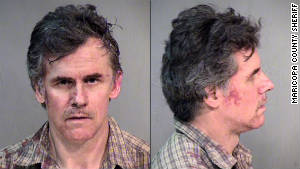
Jerald Newman, 54, was released Saturday from a Maricopa County jail, his wife, Pamela, told CNN. He has been charged with resisting arrest and shoplifting.
"(He is) as good as expected ... but he is emotionally and mentally a wreck," she said.
Newman was among a throng of shoppers crammed into a Buckeye, Arizona, Walmart soon after it opened late the night of Thanksgiving.
"They were just letting people in; there was nowhere to walk," said his daughter, Berneta Sanchez, who was also in the store. "Teenagers and adults were fighting for these games, taking them away from little kids and away from my father."
The suspect's grandson, Nicholas Nava, told CNN affiliate KNXV that Newman had grabbed one video game and put it under his shirt so that others jostling for the game didn't take it from him. One person alerted a police officer, who then approached Newman.
Jerald Newman, 54, spent Friday night in a Maricopa County jail hours after being arrested.
David Chadd, a CNN iReporter from Las Vegas, was among the crowd shopping for video games set up in the Walmart's grocery section. He said Newman "was not resisting" arrest as he was led away from the crowd by a police officer.
That officer, Chadd said, then suddenly hooked the suspect around the leg, grabbed him and "slammed him face first into the ground."
"It was like a bowling ball hitting the ground, that's how bad it was," he said.
Video, recorded by Chadd and later posted on CNN's iReport, shows an apparently unconscious Newman head-down on the floor in a pool of blood. As he's turned over, Buckeye police officers appear to try to revive him -- at which point his face, covered mostly in blood, is revealed.
Several voices, apparently those of fellow shoppers, are heard saying, "Why would you throw him down so hard? All he did was shoplifting and you threw him down like that?" Another person says, "They threw him down. He wasn't doing anything wrong."
Two citizens then appear to come to Newman's aid by applying paper towels to the man's nose. Chadd estimated Newman was knocked out for about 10 minutes, all the while gushing blood and handcuffed.
Buckeye Assistant Police Chief Larry Hall said Saturday that Newman's case is "basically in the court's hands right now, as far as the resisting arrest and shoplifting goes."
The department will conduct an investigation to assess whether the actions of the police officer involved in the arrest were "within reason," based on "our policy and also the law." He said that probe would happen soon, adding it was "days away."
"We may have an independent agency conduct the inquiry, just to show transparency," Hall said.
As to the criminal charges, Todd Nolan -- the attorney representing Newman -- said his office will conduct discovery procedures Monday with police "to gather evidence proving my client is innocent."
The suspect himself plans to speak to the media later next week, his lawyer said.
Walmart spokeswoman Ashley Hardie said the retail giant was aware of the incident.
"We are concerned whenever there is an incident involving a customer at one of our stores," Hardie said. "We are in contact with the local police and are sharing any information we have with them."
Sanchez described her father as "a really nice man," saying he is a custom furniture maker who preaches through the California prison system. He has raised his grandson from birth and, even while in the hospital, Sanchez said the boy was her father's chief concern.
Whatever happens, Sanchez vowed that next year she won't be shopping in the wee hours of the Friday morning after Thanksgiving.
"I will never leave my house again on Black Friday, because I don't want to put my daughter through that again," she said, noting her daughter was there to see police standing over her bloody grandfather. "I'd rather stay home. And if they have Black Friday, they need more security."


By Greg Botelho taken from http://edition.cnn.com/2011/11/26/justice/arizona-walmart-arrest/index.html?hpt=hp_t3

Consultation on scrapping health and safety rules

The government is launching a consultation on the abolition of "large numbers" of health and safety rules following an independent review.
It says it wants to have removed the first regulations from the statute book within a few months.
Following the Lofstedt review, a "challenge panel" is also being created for businesses unhappy with health and safety rulings made against them.
The employment minister said the moves would "root out needless bureaucracy".
The government says there are currently about 200 health and safety regulations, but this will be reduced by more than half over the next three years.
Excessive health and safety has been blamed for the banning of low-risk activities, such as royal wedding street parties, and the cancellations of school trips.
Self-employed The review was carried out by Prof Ragnar E Lofstedt, director of the Centre for Risk Management at King's College London.
He concludes that the problem "lies less with the regulations themselves and more with the way they are interpreted and applied".

Rules to be amended or scrapped

  • Health and Safety (First Aid) Regulations 1981 - remove the need for first aiders' training to be approved centrally by the Health and Safety Executive
  • Reporting of Injuries, Diseases and Dangerous Occurrences Regulations 1995 - simplify the rules surrounding the reporting workplace accidents
  • Electricity at Work Regulations 1989 - at present, businesses are unnecessarily having appliances like microwaves and kettles testing annually
  • Work at Height Regulations 2005 - remove confusion over what constitutes "height" to prevent the law being used to prohibit activities like standing on a low stools
His report says "there are instances where regulations designed to address real risks are being extended to cover trivial ones", and adds that the requirement to carry out risk assessments "has turned into a bureaucratic nightmare for some businesses".
Prof Lofstedt makes a number of recommendations to ensure that in future employers are not held responsible for damages in cases where they have done everything possible to manage risks.
He also says self-employed people whose work poses no risk to others should be exempt from health and safety rules altogether.
That would include individuals who run online shops from their home, as well as others in office roles, such as accountants, computer programmers, solicitors and graphic designers.
Prof Lofstedt suggests that up to a million self-employed people could benefit from such an exemption.
At present, the Health and Safety Executive (HSE) takes responsibility for regulating high-risk workplaces, like factories and mines, while local authorities monitor lower risk environments, like shops and hotels.
The review says that the involvement of more than 380 local authorities, each with their own priorities, had led to "real inconsistency" on health and safety matters.
To rectify this problem, it recommends that the HSE be given new powers to direct all council inspection and enforcement activities.
The report does also note that the scope to curb regulations in the UK was "severely limited" by the requirement to comply with European law.
It recommends that the government work more closely with the European Commission, particularly during a planned review of EU health and safety legislation in 2013, to ensure that both new and existing laws are genuinely based on real risks.
'Increased risk' Employment Minister Chris Grayling said the government was accepting Prof Lofstedt's recommendations and hoped to "put common sense back at the heart of health and safety".

Start Quote

It cannot be right that employers are responsible for damages when they have done all they can to manage the risk”
End Quote Chris Grayling Employment Minister
"Our reforms will root out needless bureaucracy and be a significant boost to the million self employed people who will be moved out of health and safety regulation altogether.
"We will also ensure our reforms put an emphasis on personal responsibility. It cannot be right that employers are responsible for damages when they have done all they can to manage the risk."
The Institution of Occupational Safety and Health said it was in favour of "streamlining and simplification" of the regulations, but could not "see the scope for reducing the number by half without potentially putting workers and the public under increased risk of injury or ill health".
"We are keen to examine the detail of the report more closely, and to work with others to ensure that the implementation of any changes to the health and safety system are achieved without causing harm," head of policy and public affairs Richard Jones said.
Sir Merrick Cockell, chairman of the Local Government Association, said his organisation was "looking forward to working closely with the Health and Safety Executive to develop an approach which delivers national priorities in a consistent way".
But he said "the invaluable accountability, transparency, flexibility and local understanding that drives the work of councils" must be maintained.

taken from http://www.bbc.co.uk/news/uk-politics-15919238

British man drags piano to top of mountain to serenade blind elephants

Mr Barton, 50, dragged his piano up a mountain in Kanchanaburi, Thailand, to help raise money for blind elephants.

He said: 'It was a 50th birthday present to myself. My wife and I have been working with blind elephants for many years, and I thought it might be something they would enjoy to listen to.

'I sat down and thought, what do you play to an elephant? 

'You only get a short time, so I started trawling through my books and then Slow Movement 2 from Beethoven's Pathetique Sonata just stuck.

'I had to drag the piano up a mountain - I have a really bad back, but I wanted to make the effort so I could feel like I had undergone a personal challenge.'

Yorkshire-born Paul now hopes to put on a concert with the elephants to raise funds for an electric fence for the sanctuary where they live.

taken from  http://www.metro.co.uk/weird/882849-man-drags-piano-to-top-of-mountain-to-serenade-blind-elephants#ixzz1f0zhgoAp

Mexico City claims zombie walk world record

Nearly 10,000 people have paraded in Mexico City dressed as zombies in what organisers claim is the biggest "zombie walk" ever held.
Wearing ghoulish make-up and rags splattered with fake blood, the "undead" shambled and groaned through the heart of the capital.
The current Guinness world record is held by Asbury Park in the US, where 4,093 zombies marched in 2010.
Zombie walks have grown in popularity worldwide in recent years.
The craze for dressing up as the "living dead" has been fuelled by movies, television, video games and literature.
A group in Brisbane in Australia has also laid claim to the record after massing 8,000 zombies last month.
Cultural critics have variously suggested the phenomenon may be linked to economic austerity or a critique of consumerism.
But participants usually say they are doing it for fun.
Correspondents say the craze has particular resonance in Mexico, where the "Day of the Dead" is a national celebration and where brutal killings by drugs gangs dominate the news.
Elsewhere in Latin America, Lima in Peru, Santiago in Chile and Sao Paulo in Brazil have all staged zombie walks this year.

taken from http://www.bbc.co.uk/news/world-15911862